
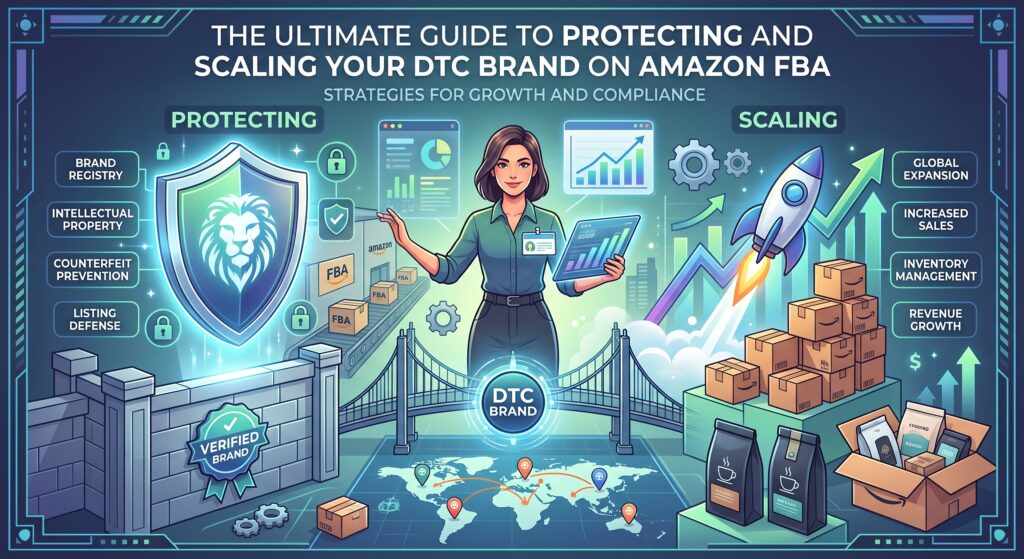
Scaling an enterprise brand on Amazon past $10M in annual Gross Merchandise Value (GMV) converts your catalog into a primary target for grey-market liquidators, unauthorized MAP violators, listing hijackers, and overseas counterfeiters. Left unmanaged, bad actors erode Buy Box ownership, suppress organic search placement, inject fake customer reviews, and destroy contribution margins.
Relying on generic Cease & Desist (C&D) letters or basic Seller Central support tickets is an outdated defense strategy. Modern Amazon brand protection requires enforcing a multi-layered security architecture: Brand Registry 2.0 automated protection, Transparency serialized 2D DataMatrix barcodes at the manufacturing level, Project Zero self-service takedowns, and the Neutral Patent Evaluation Process (APEX/NPEP). This guide provides the complete operational blueprint for protecting enterprise ASINs on Amazon.
1. Architectural Defense Stack: Brand Protection Tools Compared
Defending intellectual property (IP) on Amazon requires deploying specific platform programs aligned to distinct threat vectors across your catalog:
| Protection Program | Core Mechanism & Enforcement Layer | Primary Target Threat | Cost & Unit Economics | Recommended Software Stack |
|---|---|---|---|---|
| Amazon Brand Registry 2.0 | Automated text/image scanning, Report a Violation (RAV) tool, A+ Content lock | Trademark infringement, detail page catalog tampering, unauthorized seller listings | Free (Requires registered trademark) | Brand Registry → |
| Transparency Program | Unique serialized 2D DataMatrix code printed on every physical unit | Physical counterfeits, unauthorized FBA inventory injections, grey-market imports | $0.01 – $0.05 / unit code (Free under volume thresholds) | Transparency API → |
| Project Zero | Self-service instant ASIN/seller removal without Amazon manual review | Persistent counterfeiters, rogue listing hijackers | Free (Requires 99%+ RAV accuracy score) | Jungle Scout → |
| Neutral Patent Evaluation (APEX/NPEP) | Binding 7-week arbitration handled by independent neutral patent attorney | Utility patent infringement by knock-off competitor products | $4,000 deposit (Fully refunded if patent holder wins) | Helium 10 Alert → |
2. Physical Unit Verification: The Amazon Transparency Program
While Brand Registry protects digital listing copy, the Amazon Transparency Program secures the physical supply chain. It eliminates counterfeits at the warehouse receiving dock before a product can ever be picked, packed, or shipped.
A. Manufacturing & Scanning Mechanics
When a brand enrolls an ASIN in Transparency, Amazon issues a batch of unique, non-repeating 2D DataMatrix codes. The brand owner must apply an individual, serialized code to 100% of manufactured units—regardless of whether those units are sold on Amazon, Shopify DTC, big-box retail, or wholesale:
The Transparency Scanning Enforcement Pipeline
When shipment pallets arrive at Amazon Fulfillment Centers, automated scanner lines check for the 2D DataMatrix code. If a seller attempts to ship inventory without a valid code, Amazon flags the stock as counterfeit, blocks receiving, and destroys or holds the units.
For FBM orders, the seller must input the unique Transparency serial number into Seller Central or stream it via SP-API before printing a shipping label. Invalid or duplicate serial numbers block shipping label generation.
End consumers scan the DataMatrix code using the Amazon mobile app upon delivery to verify authentic origins, view manufacturing dates, and access brand engagement media.
3. Automated Enforcement: Project Zero Self-Service Takedowns
Filing manual infringement reports through Seller Central can take days, during which a hijacker can drain tens of thousands of dollars in Buy Box revenue. Project Zero grants qualified enterprise brand owners self-service administrative rights to remove counterfeit listings immediately without Amazon agent intervention.
A. Qualification & Accuracy Requirements
Access to Project Zero is not open by default. To unlock self-service takedown permissions, a brand must satisfy three administrative conditions:
- Active Brand Registry 2.0 Account: Must hold a registered government trademark in the target jurisdiction.
- Rights Owner Authority: The account must be listed as the primary Trademark Rights Owner.
- 99%+ RAV Accuracy Threshold: Over the preceding 6 months, the brand must have submitted valid infringement reports through the Report a Violation (RAV) tool with an acceptance accuracy rate exceeding 99%.
4. Expedited Arbitration: Neutral Patent Evaluation (APEX/NPEP)
Traditional federal patent litigation costs between $250,000 and $1,500,000+ and takes 18 to 36 months to reach trial. Meanwhile, overseas competitors selling utility patent knock-offs can dominate Amazon search placement.
Amazon’s Neutral Patent Evaluation Process (NPEP)—formerly known as APEX—is a binding, expedited arbitration pipeline designed specifically for utility patent enforcement:
The 7-Week NPEP Utility Patent Arbitration Sequence
Patent owner files NPEP claim identifying up to 20 infringing ASINs and target claim chart.
Accused sellers receive notice. Must sign agreement and deposit $4,000 within 21 days or ASINs are removed.
Neutral patent attorney selected. Both sides submit written briefs (20-page max). No live discovery.
Evaluator rules. Winner gets $4,000 deposit returned; loser forfeits deposit. Infringing ASINs removed globally.
5. Algorithmic Buy Box Defense: SP-API Hijacker Detection Script
To catch unauthorized Buy Box sellers instantly before they alter listing images or undercut minimum advertised price (MAP) thresholds, software engineers deploy automated Selling Partner API (SP-API) monitoring scripts.
Below is a production-ready Python script utilizing SP-API notification webhooks and competitive pricing endpoints to detect unauthorized Buy Box sellers in real time:
Python SP-API Buy Box & Hijacker Alert Monitoring Script
import requests
import json

def audit_buy_box_sellers(
    asin: str,
    authorized_seller_ids: list,
    access_token: str,
    marketplace_id: str = "ATVPDKIKX0DER" # US Marketplace
):
    """
    Queries Amazon SP-API Product Pricing API to detect unauthorized sellers
    winning or competing on the Buy Box for a designated ASIN.
    """
    endpoint = f"https://sellingpartnerapi-na.amazon.com/products/pricing/v0/items/{asin}/offers"

    headers = {
        "x-amz-access-token": access_token,
        "Content-Type": "application/json"
    }

    params = {
        "MarketplaceId": marketplace_id,
        "ItemCondition": "New"
    }

    response = requests.get(endpoint, headers=headers, params=params)

    if response.status_code == 200:
        payload = response.json()
        offers = payload.get("payload", {}).get("Offers", [])

        unauthorized_sellers = []
        for offer in offers:
            seller_id = offer.get("SellerId")
            price = offer.get("ListingPrice", {}).get("Amount")
            is_buy_box_winner = offer.get("IsBuyBoxWinner", False)

            if seller_id not in authorized_seller_ids:
                unauthorized_sellers.append({
                    "seller_id": seller_id,
                    "price": price,
                    "is_buy_box_winner": is_buy_box_winner
                })

                if is_buy_box_winner:
                    print(f"[CRITICAL ALERT] Buy Box Hijacked on ASIN {asin} by Seller: {seller_id} at ${price}")
                else:
                    print(f"[WARNING] Unauthorized Listing Offer Detected on ASIN {asin} by Seller: {seller_id}")

        return unauthorized_sellers
    else:
        print(f"SP-API Request Failed: {response.status_code} - {response.text}")
        return None

# Execute Monitoring for Brand ASIN
authorized_ids = ["A2EXAMPLE12345", "A3AUTHORIZED678"]
audit_buy_box_sellers(
    asin="B08EXAMPLE",
    authorized_seller_ids=authorized_ids,
    access_token="Atzr|IwEBI..."
)
Frequently Asked Questions
How does the Amazon Transparency Program stop counterfeiters at FBA receiving centers?
The Amazon Transparency Program assigns unique, alphanumeric 2D DataMatrix barcodes to every physical unit manufactured. When inventory arrives at Amazon FBA fulfillment centers or is scanned during merchant-fulfilled (FBM) shipping, Amazon’s systems scan the code. If a unit lacks a valid, un-used Transparency code generated by the brand owner, Amazon immediately flags it as counterfeit, prevents receiving, and quarantines the stock.
What accuracy threshold is required to maintain Project Zero self-service takedown privileges?
Brands using Project Zero’s self-service counterfeit removal tool must maintain a 99%+ submission accuracy rate. Amazon continuously audits self-service takedowns. If a brand abuses the tool or submits inaccurate trademark/copyright claims, Amazon revokes self-service removal privileges and degrades Brand Registry account health.
How does the Amazon Neutral Patent Evaluation Process (NPEP / APEX) resolve utility patent disputes?
NPEP is an expedited arbitration program for utility patent holders. The patent owner and accused seller each deposit $4,000 with a neutral, third-party patent attorney selected by Amazon. The evaluator reviews written briefs over a 7-week window. If the evaluator finds infringement, the accused ASINs are removed globally, and the patent owner’s $4,000 deposit is refunded while the infringer forfeits theirs. If no infringement is found, the seller receives their $4,000 back.
Protect Your Amazon ASINs & Buy Box Revenue
We configure Amazon Transparency 2D DataMatrix manufacturing integration, setup SP-API hijacker alerts, and represent brand owners inside Amazon NPEP neutral patent arbitrations.
Book a Brand Protection Audit →